
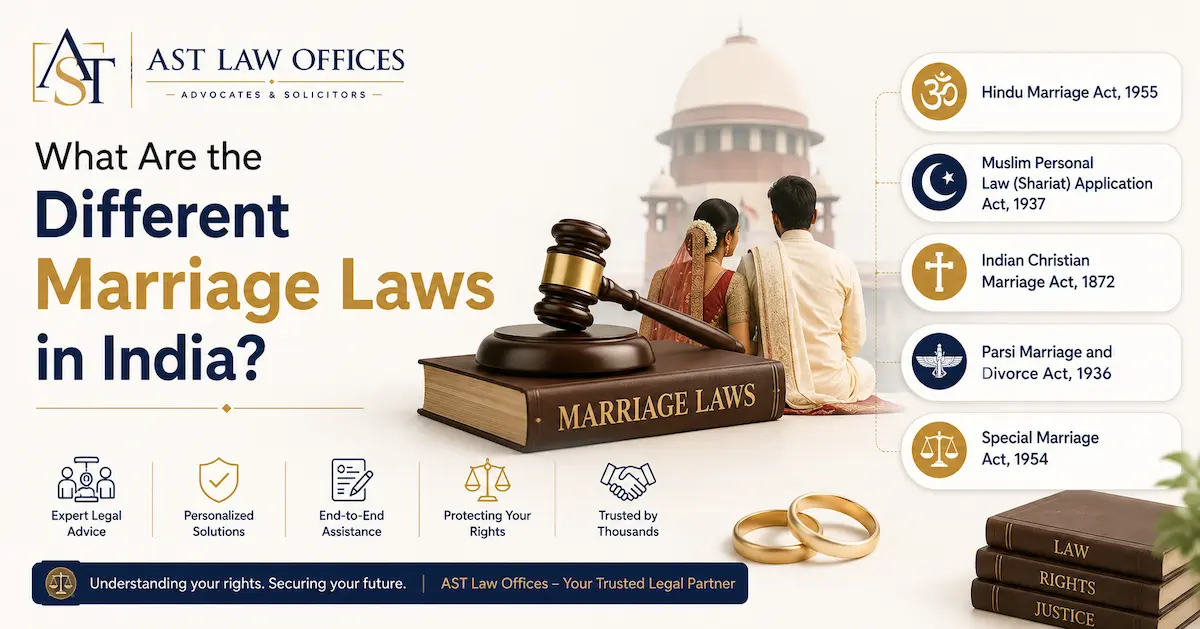
What Are the Different Marriage Laws in India?
Marriage in India is not governed by a single, uniform statute. India follows a plural legal framework, under which different communities may be governed by different personal laws, while the Special Marriage Act, 1954 provides a secular statutory route for civil marriages. The principal frameworks include the Hindu Marriage Act, Muslim personal law, the Indian Christian Marriage Act, the Parsi Marriage and Divorce Act, and the Special Marriage Act.
Understanding which law applies to a marriage is important because the applicable legal framework can affect matters such as the validity of the marriage, solemnisation, registration, divorce, maintenance and other matrimonial rights.
This article provides an overview of the major marriage laws in India and explains how they differ.
Why Does India Have Different Marriage Laws?
India is a country with diverse religious and cultural traditions. Its legal system recognises several personal-law frameworks governing family and matrimonial matters.
The major marriage-law frameworks include:
- Hindu Marriage Act, 1955
- Muslim Personal Law
- Indian Christian Marriage Act, 1872
- Parsi Marriage and Divorce Act, 1936
- Special Marriage Act, 1954
There are also customary and certain region-specific laws that may apply in particular circumstances.
Therefore, the legal requirements for a valid marriage can differ depending on the parties, their religion, the form in which the marriage is solemnised and the law under which it is conducted.
1. Hindu Marriage Act, 1955
The Hindu Marriage Act, 1955 (HMA) is the principal legislation governing Hindu marriages. Its application extends to Hindus and, for the purposes of the Act, Buddhists, Jains and Sikhs, subject to the statutory provisions.
Important Conditions
The Act lays down conditions relating to:
- Existing spouse
- Minimum age
- Mental capacity to consent
- Prohibited degrees of relationship
- Sapinda relationships
Generally, neither party should have a living spouse at the time of marriage, and the statutory age requirements must be satisfied.
Marriage Ceremonies
The marriage must be solemnised according to the customary rites and ceremonies of either party. Where the ceremony includes Saptapadi, the marriage becomes complete when the seventh step is taken.
Other Matters Covered
The Hindu Marriage Act also provides a legal framework concerning:
- Restitution of conjugal rights
- Judicial separation
- Nullity of marriage
- Divorce
- Maintenance
- Other matrimonial reliefs
2. Muslim Marriage Law in India
Muslim marriages in India are primarily governed by Muslim personal law, rather than a single comprehensive marriage statute comparable to the Hindu Marriage Act.
Under Muslim law, Nikah is generally understood as a civil contract with religious significance.
Important aspects may include:
- Offer and acceptance
- Free consent
- Capacity of the parties
- Mahr or dower
- Witnesses, depending on the applicable school and circumstances
- Absence of prohibited relationships
The legal position can vary according to the relevant personal-law principles and circumstances.
Triple Talaq
The legal position regarding instant triple talaq is particularly important. The Muslim Women (Protection of Rights on Marriage) Act, 2019 declares the pronouncement of talaq in the specified instant form void and illegal and provides for criminal consequences.
Therefore, individuals should not rely on outdated information concerning the legal effect of instant triple talaq.
3. Indian Christian Marriage Act, 1872
Christian marriages in India are primarily governed by the Indian Christian Marriage Act, 1872, along with other applicable matrimonial legislation, including the Divorce Act, 1869 in relevant matters.
The Indian Christian Marriage Act regulates the solemnisation of Christian marriages and provides requirements concerning authorised persons, ceremonies and related procedures.
Depending on the circumstances, a marriage may be solemnised through an authorised minister or Marriage Registrar in accordance with the statutory requirements.
Important Considerations
Christian marriage law may involve requirements relating to:
- Notice
- Authorised person
- Place of solemnisation
- Witnesses
- Marriage certificate
- Registration
Couples should verify the applicable requirements before the ceremony.
4. Parsi Marriage and Divorce Act, 1936
The Parsi Marriage and Divorce Act, 1936 governs marriage and matrimonial matters involving Parsis.
One distinctive requirement is the Ashirvad ceremony, which forms an important part of a valid Parsi marriage under the Act.
The Act also contains provisions concerning:
- Marriage conditions
- Registration
- Divorce
- Matrimonial disputes
- Prohibited relationships
Parsi marriages are therefore governed by a specific statutory framework reflecting the community’s personal law.
5. Special Marriage Act, 1954
The Special Marriage Act, 1954 (SMA) provides a secular statutory framework for marriage.
It is particularly relevant for couples who:
- Belong to different religions
- Prefer a civil marriage
- Do not wish to solemnise their marriage under a religious personal law
The Act provides for solemnisation of marriages as well as registration of certain marriages celebrated in other forms.
Why Is the Special Marriage Act Important?
The Act provides a legal route for interfaith and civil marriages without requiring the parties to convert their religion merely to marry under a different personal law.
It also contains provisions dealing with matrimonial reliefs, including divorce.
Hindu Marriage Act vs Special Marriage Act
One of the common questions couples have is the difference between these two laws.
| Point | Hindu Marriage Act | Special Marriage Act |
| Nature | Personal-law statute | Secular civil-marriage statute |
| Primarily applies to | Hindus, Buddhists, Jains & Sikhs | Persons choosing marriage under the Act |
| Religious ceremony | Applicable customary rites are relevant | Civil solemnisation under the Act |
| Interfaith marriage | Generally not the route for interfaith couples | Common statutory route |
| Divorce | Provided under the Act | Provided under the Act |
| Conversion required | No, where HMA applies | No religious conversion merely to marry under SMA |
The Special Marriage Act has its own statutory conditions and procedures, so couples should understand those requirements before choosing this route.
What Are the Common Legal Requirements for Marriage?
Although requirements differ between legal frameworks, several issues commonly arise when determining whether a marriage is legally valid.
1. Minimum Age
The general statutory minimum marriage age is 21 years for men and 18 years for women under the major central marriage statutes. The Prohibition of Child Marriage Act, 2006 also provides a broader legal framework concerning child marriage.
2. Free Consent
Consent is an important component of a valid marriage. The applicable law may provide remedies where consent was obtained through coercion, fraud or other legally recognised circumstances.
3. Existing Marriage
Under several statutory frameworks, a person cannot validly enter into another marriage while a previous spouse is living.
However, the position concerning multiple marriages can differ depending on the personal law applicable to the parties. The legal consequences should therefore be assessed according to the specific circumstances.
4. Prohibited Relationships
Marriage between persons falling within specified prohibited degrees of relationship may not be valid, subject to exceptions recognised by the applicable law or custom.
5. Marriage Ceremony
The required form of solemnisation varies significantly.
For example, Hindu marriages may require customary ceremonies recognised by the HMA, while Parsi marriages have their own statutory ceremonial requirements.
Is Marriage Registration Mandatory in India?
Marriage registration is an important legal safeguard because a marriage certificate can provide documentary proof of the marital relationship.
The registration framework can vary depending on:
- The law under which the marriage was solemnised
- The state
- The applicable registration rules
- The circumstances of the parties
India does not have one single registration procedure applicable identically to every marriage throughout the country.
A registered marriage certificate can be particularly useful for:
- Passport applications
- Visa and immigration matters
- Insurance claims
- Banking and financial documentation
- Property-related matters
- Government records
- Matrimonial proceedings
What About Interfaith Marriages?
Interfaith couples generally need to carefully consider the legal framework under which they wish to marry.
The Special Marriage Act, 1954 provides a secular statutory route for persons belonging to different religions.
The Act contains specific procedural requirements, including provisions concerning notice and solemnisation.
Because interfaith marriage can involve questions concerning personal law, conversion, registration and state-specific requirements, couples should obtain legal advice before beginning the process.
Marriage Laws and Divorce in India
The applicable marriage law also has an important impact on matrimonial remedies.
Depending on the legal framework, the parties may have statutory provisions dealing with:
- Divorce
- Judicial separation
- Nullity
- Maintenance
- Restitution of conjugal rights
- Custody and related family-law issues
For example, the Hindu Marriage Act contains specific grounds and procedures for matrimonial relief, while the Special Marriage Act has its own provisions governing divorce and related remedies.
Muslim, Christian and Parsi matrimonial matters are governed through their respective statutory and personal-law frameworks.
Why Choosing the Correct Legal Framework Matters
Selecting or identifying the applicable marriage law is important because it can affect:
Validity
Whether the marriage satisfies the statutory or personal-law requirements.
Registration
Where and how the marriage can be registered.
Divorce
Which statute governs matrimonial proceedings.
Maintenance
The legal provisions potentially available to a spouse.
Property and Succession
The applicable personal-law and statutory framework may affect certain succession and property questions.
Interfaith Issues
The legal route for an interfaith couple may differ from that of a couple marrying under a personal law.
Common Mistakes Couples Should Avoid
1. Assuming Every Marriage Follows the Same Law
India’s marriage laws differ according to the applicable legal framework.
2. Ignoring Registration
Even where the marriage is legally solemnised, obtaining appropriate documentary proof can be extremely important.
3. Relying on Informal Advice
Family and community practices do not always reflect current legal requirements.
4. Ignoring Interfaith Legal Requirements
Interfaith couples should understand the applicable statutory procedure before planning the marriage.
5. Using Outdated Information
Marriage and family law continue to evolve through legislation and court decisions.
Comparison of Major Marriage Laws in India
| Marriage Framework | Primarily Applicable To | Key Feature |
| Hindu Marriage Act, 1955 | Hindus, Buddhists, Jains & Sikhs | Marriage under applicable Hindu/customary ceremonies |
| Muslim Personal Law | Muslims | Nikah governed primarily by Muslim personal-law principles |
| Indian Christian Marriage Act, 1872 | Christians | Statutory framework for solemnisation of Christian marriages |
| Parsi Marriage & Divorce Act, 1936 | Parsis | Specific statutory and ceremonial requirements |
| Special Marriage Act, 1954 | Persons choosing civil marriage under the Act | Secular statutory marriage framework |
This is a simplified overview. The precise law applicable to an individual marriage depends on the parties and facts.
How AST Law Offices Can Help
Marriage can have significant legal consequences, particularly where the parties have different religions, different nationalities, previous marriages, property interests or international connections.
AST Law Offices can assist with family and matrimonial legal matters including:
- Marriage-related legal advice
- Marriage registration
- Interfaith marriage matters
- Special Marriage Act matters
- Divorce proceedings
- Matrimonial disputes
- Maintenance matters
- Judicial separation
- Child custody matters
- Property-related matrimonial disputes
- NRI and cross-border matrimonial matters
If you are unsure which marriage law applies to your circumstances, obtaining legal advice before proceeding can help avoid unnecessary complications later.
Frequently Asked Questions
1. How many marriage laws are there in India?
India does not have a single marriage law. Major frameworks include the Hindu Marriage Act, Muslim personal law, Indian Christian Marriage Act, Parsi Marriage and Divorce Act and Special Marriage Act. Other customary and region-specific laws may also be relevant in particular cases.
2. Which law applies to Hindu marriages?
The Hindu Marriage Act, 1955 generally applies to Hindus and also covers Buddhists, Jains and Sikhs within its statutory scope.
3. Which law applies to Muslim marriages?
Muslim marriages are primarily governed by Muslim personal law, along with applicable legislation governing specific matrimonial issues.
4. Can people of different religions marry in India?
Yes. The Special Marriage Act, 1954 provides a secular statutory route for interfaith marriages, subject to its conditions and procedure.
5. Is court marriage the same as a religious marriage?
Not necessarily. A civil marriage under the Special Marriage Act is a statutory form of marriage and does not depend on a religious ceremony in the same way as a marriage solemnised under a personal law.
6. Is marriage registration important?
Yes. Registration and a marriage certificate provide important documentary evidence of the marriage and can be useful for legal, administrative, immigration and financial purposes.
7. Does the same law govern marriage and divorce?
The applicable matrimonial framework generally determines the relevant provisions for divorce and other matrimonial remedies, although different statutes may interact depending on the circumstances.
Conclusion
India’s marriage-law framework reflects the country’s religious and legal diversity. Rather than having one uniform statute governing every marriage, India recognises different personal-law and statutory frameworks, including the Hindu Marriage Act, Muslim personal law, Indian Christian Marriage Act, Parsi Marriage and Divorce Act and Special Marriage Act.
For couples, understanding the law applicable to their marriage is important not only at the time of solemnisation but also in relation to registration, divorce, maintenance, succession and other matrimonial matters.
If you are planning a marriage, especially an interfaith, NRI or cross-border marriage, taking legal advice at the outset can help you understand the applicable procedure and avoid complications later.
AST Law Offices provides legal assistance in family and matrimonial matters in Delhi, including marriage-related disputes, interfaith marriage matters and matrimonial proceedings.