
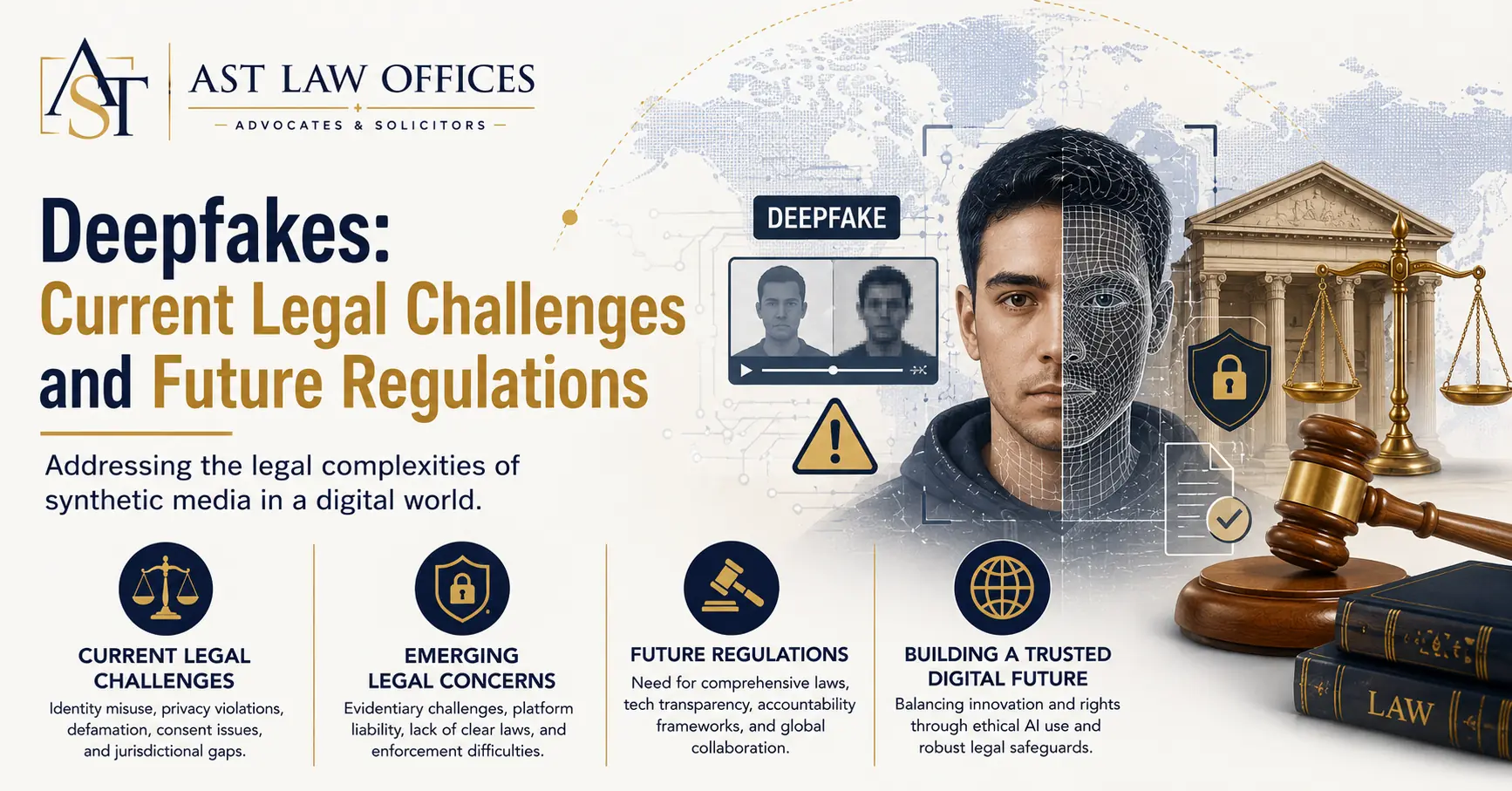
Deepfakes: Current Legal Challenges and Future Regulations
Artificial Intelligence (AI) has transformed industries ranging from healthcare and education to entertainment and finance. One of its most powerful—and controversial—applications is deepfake technology. While deepfakes have legitimate uses in filmmaking, education, and accessibility, they also present significant legal, ethical, and security concerns.
The increasing sophistication of AI-generated images, videos, and audio recordings has made it increasingly difficult to distinguish genuine content from fabricated media. As a result, governments, regulators, businesses, and legal professionals worldwide are grappling with the challenge of balancing innovation with accountability.
This article explores the current legal challenges associated with deepfakes, the existing legal framework in India, international regulatory developments, and the future of AI governance.
What Are Deepfakes?
Deepfakes are digitally created or manipulated images, videos, or audio recordings generated using Artificial Intelligence, particularly deep learning algorithms.
These technologies can:
- Replace faces in videos
- Clone voices
- Generate realistic human speech
- Create fabricated video footage
- Produce synthetic photographs
- Manipulate existing media
While many deepfakes are created for entertainment, others are used for fraud, political manipulation, cybercrime, harassment, and misinformation.
How Deepfakes Work
Most deepfakes are created using machine learning models trained on large datasets of images, videos, and voice recordings.
AI systems learn facial expressions, speech patterns, body movements, and voice characteristics before generating synthetic media that closely resembles the original individual.
As AI technology continues to improve, detecting manipulated content becomes increasingly difficult.
Legitimate Uses of Deepfake Technology
Despite the risks, deepfake technology also has positive applications.
Examples include:
- Film production
- Video localisation
- Digital restoration of historical footage
- Educational simulations
- Virtual training
- Accessibility tools
- Voice reconstruction for medical purposes
- Gaming and virtual reality
- Advertising
The challenge lies not in the technology itself but in preventing its misuse.
Growing Legal Concerns
Deepfakes create legal issues across multiple areas of law.
Some of the most significant concerns include:
- Identity theft
- Privacy violations
- Online harassment
- Election misinformation
- Financial fraud
- Defamation
- Copyright infringement
- Intellectual property misuse
- Cybercrime
- Consumer deception
As deepfakes become more convincing, traditional legal frameworks face increasing pressure.
Privacy and Personality Rights
One of the biggest legal issues involves the unauthorized use of a person’s image, voice, or likeness.
Deepfakes may:
- Misrepresent individuals
- Damage reputations
- Invade privacy
- Cause emotional distress
- Facilitate identity theft
Public figures, celebrities, business leaders, and private individuals have all become targets of AI-generated impersonation.
The legal challenge lies in determining liability when synthetic media spreads rapidly across digital platforms.
Defamation and Reputation Damage
Deepfakes can be used to create false videos or audio recordings depicting individuals making statements or engaging in activities that never occurred.
Potential consequences include:
- Professional harm
- Political manipulation
- Employment consequences
- Business losses
- Personal distress
Traditional defamation laws apply in many situations, but identifying anonymous creators and removing viral content often presents practical difficulties.
Cybercrime and Financial Fraud
Cybercriminals increasingly use AI-generated voices and videos for fraud.
Examples include:
- CEO impersonation
- Banking scams
- Fake customer support
- Investment fraud
- Identity verification fraud
- Social engineering attacks
Businesses now face new cybersecurity challenges because traditional verification methods can be manipulated using AI.
Election Misinformation
Deepfakes have become a significant concern during elections.
Manipulated media may:
- Spread false political statements
- Influence voters
- Damage public trust
- Misrepresent candidates
- Amplify misinformation
Election regulators worldwide are evaluating methods to reduce AI-generated electoral manipulation while protecting freedom of expression.
Intellectual Property Issues
AI-generated content raises complex copyright questions.
Legal issues include:
- Ownership of AI-generated works
- Unauthorized use of copyrighted material
- Voice cloning
- Image licensing
- Trademark misuse
- Commercial exploitation of likeness
Courts around the world continue to examine how existing intellectual property laws should apply to AI-generated content.
Deepfakes and Consent
One of the most sensitive issues involves consent.
Deepfake technology has been used to create:
- Non-consensual intimate images
- Fake endorsements
- Unauthorized advertisements
- Synthetic interviews
- False educational content
Many jurisdictions are introducing laws specifically targeting non-consensual synthetic media.
Current Indian Legal Framework
India does not yet have a dedicated statute exclusively regulating deepfakes. However, several existing laws may apply depending on the facts of a particular case.
These include:
Information Technology Act, 2000
Certain provisions may apply where deepfakes involve:
- Identity theft
- Impersonation
- Computer-related offences
- Publication of unlawful material
- Electronic fraud
Bharatiya Nyaya Sanhita (BNS)
Depending on the conduct involved, offences relating to cheating, forgery, impersonation, defamation, obscenity, criminal intimidation, or fraud may be relevant under applicable criminal law.
Copyright Law
Where copyrighted material is copied without authorization, copyright remedies may be available.
Trademark Law
Deepfakes used for false endorsements or brand impersonation may also raise trademark and passing-off issues.
Privacy Jurisprudence
Following the recognition of privacy as a fundamental right by the Supreme Court of India, unauthorized use of personal identity may also give rise to civil and constitutional issues, depending on the circumstances.
Challenges for Law Enforcement
Deepfake investigations often involve:
- Anonymous creators
- Foreign hosting platforms
- Encrypted communication
- Rapid viral distribution
- Cross-border jurisdiction
- Digital evidence preservation
Investigators frequently require technical expertise to authenticate digital content and trace its origin.
International Regulatory Developments
Governments around the world are introducing new AI regulations.
Several jurisdictions are considering or implementing measures relating to:
- AI transparency
- Watermarking AI-generated content
- Mandatory disclosure
- Platform accountability
- Election safeguards
- Risk-based AI regulation
The European Union’s AI Act is one of the most comprehensive legislative efforts to regulate artificial intelligence, including transparency obligations for certain AI-generated content.
Future Regulations in India
India is expected to continue developing its AI governance framework as artificial intelligence becomes increasingly integrated into business and society.
Future regulatory measures may include:
- Mandatory AI content disclosure
- Digital watermarking requirements
- Stronger platform obligations
- Enhanced penalties for malicious deepfakes
- Election-specific safeguards
- Protection of biometric identity
- AI risk assessments
- Cross-border enforcement cooperation
The objective will likely be to encourage responsible innovation while protecting individuals and businesses from misuse.
What Businesses Should Do
Businesses should proactively prepare for AI-related risks.
Recommended measures include:
- AI governance policies
- Employee awareness training
- Cybersecurity improvements
- Identity verification protocols
- Digital monitoring
- Brand protection strategies
- Incident response planning
- Contractual AI compliance provisions
Early preparation can significantly reduce legal and commercial exposure.
Best Practices for Individuals
Individuals should:
- Verify suspicious content
- Protect personal information
- Use strong privacy settings
- Report fake media promptly
- Preserve digital evidence
- Seek legal advice where appropriate
Awareness remains one of the most effective defences against AI-enabled fraud.
How AST Law Offices Can Assist
As artificial intelligence continues to reshape the legal landscape, businesses and individuals increasingly require legal guidance on technology-related risks.
AST Law Offices advises clients on matters involving:
- Cyber law
- Online fraud
- Digital identity misuse
- Defamation
- Commercial disputes
- Intellectual property
- Data protection
- Technology contracts
- AI-related legal risk assessment
- Cross-border digital disputes
Whether you are dealing with AI-generated misinformation, digital impersonation, online reputation issues, or technology-related commercial disputes, obtaining timely legal advice can help protect your rights and interests.
Frequently Asked Questions
Are deepfakes illegal in India?
Deepfakes are not inherently illegal. However, depending on how they are created or used, they may violate laws relating to fraud, impersonation, defamation, privacy, intellectual property, cybercrime, or other applicable legal provisions.
Can someone create a deepfake using my photograph?
Using another person’s image without consent may give rise to legal consequences depending on the circumstances, particularly if it causes harm, deception, or violates applicable laws.
Can businesses become victims of deepfake fraud?
Yes. Businesses may face AI-enabled impersonation, executive fraud, fake payment requests, brand misuse, and reputational harm through manipulated digital content.
How can companies reduce deepfake risks?
Businesses should implement robust cybersecurity measures, employee training, identity verification procedures, AI governance policies, and incident response plans.
Will India introduce specific deepfake laws?
India is actively considering broader AI governance measures. As technology evolves, additional legislation or regulatory guidance specifically addressing synthetic media and AI-generated content may emerge.
Conclusion
Deepfake technology demonstrates both the transformative potential and the legal complexity of artificial intelligence. While it offers exciting opportunities for innovation, it also creates significant risks relating to privacy, cybersecurity, misinformation, intellectual property, and commercial fraud.
As governments continue to develop AI-specific regulations, businesses and individuals should adopt proactive compliance strategies and remain informed about evolving legal obligations. A combination of responsible technological development, effective regulation, and informed legal guidance will be essential to ensuring that AI serves society without undermining trust, security, or fundamental rights.